With the 2026/27 academic year now underway, schools across England are putting new allergy safety requirements into practice.
Often referred to as Benedict's Law, the new statutory allergy safety guidance places greater emphasis on how schools identify and manage allergy risks, including allergy policies, staff training, individual healthcare plans and emergency procedures.
But while allergy safety is a whole-school responsibility, the kitchen has an important role to play.
From knowing exactly which allergens are present in a dish to making sure PPDS food is labelled correctly, a clear and consistent food labelling process can help school catering teams manage allergen information more effectively.
So, how confident are you that your school's food labelling procedures are up to scratch?
What Should Schools Be Considering Now?
The Department for Education's new Allergy Safety in Schools statutory guidance applies in England and sets out what schools must do to support pupils with allergies.
This includes having an allergy safety policy, providing allergy awareness training for staff, identifying pupils who require Individual Healthcare Plans and recording and learning from serious incidents and near misses.
For catering teams, the Government's new School Food Standards: Allergy Guide, published in September 2026, provides specific practical advice around managing food allergy risks.
Schools and caterers should:
- Check product changes with food suppliers
- Make sure catering staff read food labels and product information
- Keep a clear record of the allergens in meals
- Ensure allergen ingredients remain identifiable
- Consider pupils with allergies when making menu changes or substitutions
- Make sure allergen information is available for the food being served.
This makes clear, consistent food labelling an important part of the wider allergy management process.
What Is PPDS Food and What Needs to Be Labelled?
One area schools should pay particular attention to is prepacked for direct sale (PPDS) food.
PPDS food is food that is packaged on the same premises where it is offered or sold, before the consumer selects or orders it.
In schools, examples can include:
- Fruit pots
- Breakfast pots
- Packaged sandwiches
- Salad boxes
- Packaged burgers
- Boxes of chips or chicken nuggets prepared and packaged ahead of a lunchtime rush.
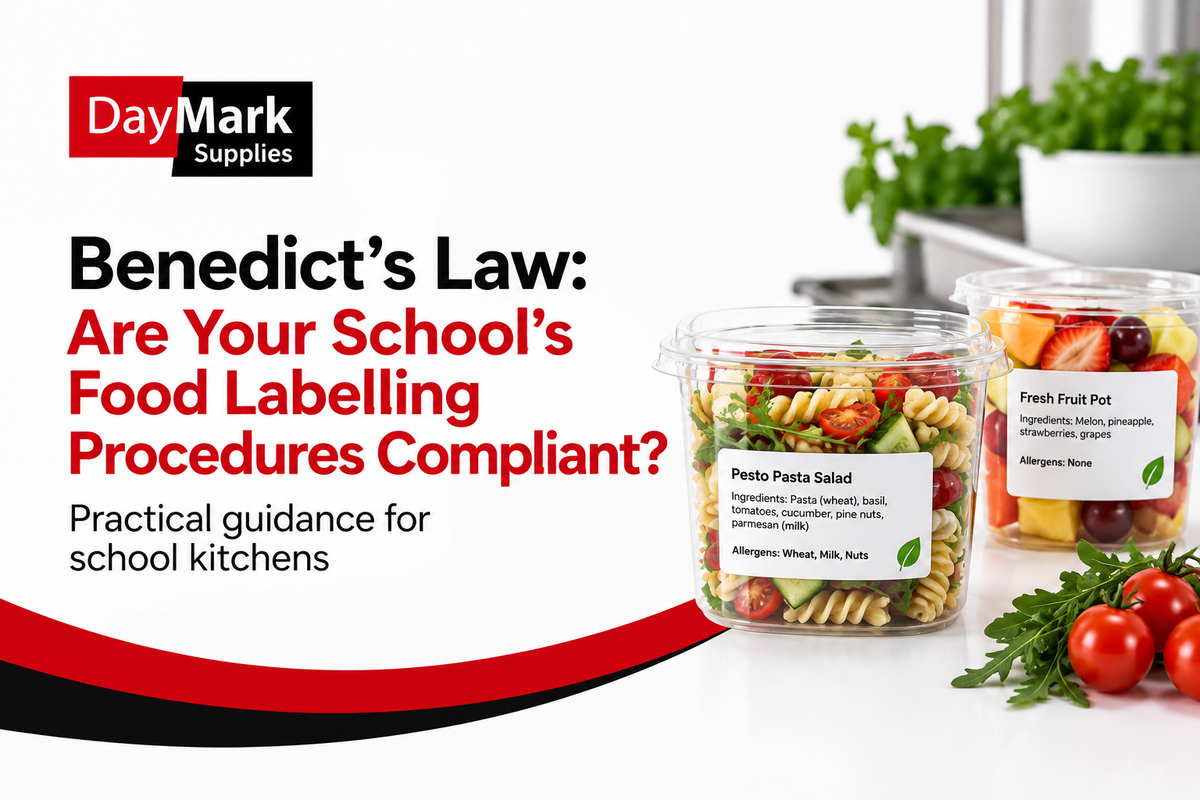
Under the PPDS allergen labelling requirements, these foods need a label containing:
The name of the food
A full ingredients list
Any of the 14 allergens present, emphasised within the ingredients list
Allergens can be emphasised using methods including bold type, capital letters, contrasting colours or underlined text, provided the emphasis is clear enough for the consumer to read.
What isn't PPDS?
Not everything prepared in a school kitchen falls under PPDS.
Food that is made or plated to order is not PPDS, nor is unpackaged food such as food served loose from a counter. These foods still have allergen information requirements, but the specific PPDS labelling requirements do not apply.
This distinction is important when reviewing your school's food labelling procedures.
Benedict's Law vs Natasha's Law: What's the Difference?
The two are closely connected when it comes to allergy safety, but they are not the same thing.
Benedict's Law
The term commonly used to describe the new statutory allergy safety requirements for schools.
The Department for Education's statutory guidance covers areas including:
- Allergy safety policies
- Staff allergy awareness training
- Individual Healthcare Plans
- Allergy incident and near-miss recording
- Emergency procedures and allergy management.
Natasha's Law
Natasha's Law refers to the allergen labelling requirements for prepacked for direct sale (PPDS) food.
For schools that produce PPDS food, the requirements include providing the food name, a full ingredients list and emphasising the 14 allergens contained within the food.
In simple terms:
Benedict's Law = wider allergy safety across the school
Natasha's Law = specific allergen labelling requirements for PPDS food
They address different areas, but both are relevant when schools are reviewing how food allergies are managed.
School Kitchen Food Labelling Checklist
Not sure where to start?
Use this quick checklist to review your current process:
Allergy information
☐ Are the allergens in each meal clearly identified?
☐ Is allergen information kept up to date when ingredients change?
☐ Do catering staff check product labels and supplier information?
☐ Can kitchen and serving staff quickly access allergen information?
PPDS food
☐ Have you identified which foods in your kitchen are PPDS?
☐ Does PPDS food have the correct food name?
☐ Is there a full ingredients list?
☐ Are allergens clearly emphasised within the ingredients list?
☐ Are PPDS items labelled before they are offered or selected by the consumer?
Kitchen processes
☐ Is there a consistent labelling process across the kitchen?
☐ Can staff easily identify prepared food?
☐ Are dietary requirements clearly communicated?
☐ Are food preparation and use-by information clearly recorded?
☐ Do all relevant members of staff understand the process?
If you've answered “no” or “not sure” to several of these, it could be a good time to review your school's food labelling system.
How Can DayMark Help?
Creating clear and consistent food labels doesn't have to mean adding more paperwork to an already busy school kitchen.
DayMark Supplies provides a range of food labelling solutions designed for professional catering environments, from individual allergen and dietary labels to digital food labelling systems.
Matt85 Printer & Tablet
For kitchens looking to move away from handwritten labels, the Matt85 provides a digital way to create consistent food labels quickly.
Products and ingredients can be stored in the MenuPilot software, with the information then synced to a tablet used to operate the printer. Labels can automatically include information such as ingredients and use-by dates, helping streamline the labelling process.
The thermal printer also requires no ink replacement, while online training and ongoing support are included.
Explore the Matt85 Printer & Tablet
Allergen & Dietary Labels
For kitchens that need a simple way to identify specific allergens or dietary requirements, DayMark also offers a range of allergen and dietary alert labels.
The range includes labels covering the 14 major allergens alongside dietary alerts such as Gluten Free, Dairy Free, Vegan, Vegetarian and Nut Free.
These can provide a quick visual way for kitchen teams to identify relevant food information during preparation and service.
Explore Allergen & Dietary Labels
Is Your School Kitchen Ready?
The introduction of new allergy safety requirements makes this a good time for schools to look beyond their written allergy policy and consider how allergen information is managed in the kitchen every day.
A clear labelling process can help your team keep food information organised, make important information easier to identify and support the wider allergy safety procedures already in place.
Whether you're reviewing PPDS labelling, looking for a quicker way to produce food labels or simply want to make allergen information easier for your team to identify, DayMark has solutions to help.
Make food labelling simpler.
Sources
- UK Government. Allergy safety in schools. Available at: https://www.gov.uk/government/publications/allergy-safety-in-schools (Accessed September 2026).
- UK Government. School food standards: allergy guide. Available at: https://www.gov.uk/government/publications/school-food-standards-allergy-guide/school-food-standards-allergy-guide (Accessed September 2026).
- Food Standards Agency. Prepacked for direct sale (PPDS) allergen labelling changes for schools, colleges and nurseries. Available at: (Accessed September 2026).